


Dr. Suzanne Lang
Dr. N Suzanne Lang
Associate Professor
A322 Plant and Soil Sciences
Michigan State University
East Lansing, MI 48824-1325
Phone: 517/355-5191, ext 377
Fax: 517/353-0890
Education:
Ph.D. 1987. Horticulture (emphasizing plant physiology), North Carolina State University, Raleigh, N.C. Dissertation title: Influences of Environmental Factors on Carbohydrate Metabolism in Cucumber.
M.S. 1983. Horticulture, Clemson University, Clemson, S.C. Thesis title: Interactive Microcomputer Landscape Design
B.S. 1977. Horticulture (emphasis in floriculture, production and plant science), Michigan State University, East Lansing, Mich. Cum laude
Teaching and Advising Responsibilities:
CSS/HRT 282 – Turfgrass Physiology. Spring 2005. Material covered: Physiological principles of turfgrass growth and development. Water relations, light, temperature, respiration, photosynthesis, mineral nutrition, and hormone action. Impact of mowing, cultivation, and traffic on turfgrass growth. Offered first ten weeks of the semester.
HRT 401 - Physiology and Management of Herbaceous Plants. Fall 2001, 2002, 2003, 2004. Material covered: Physiological and growth responses of herbaceous plants to light, temperature, nutrients and gases. Management of these for optimum production.
HRT 203 - Principles of Horticulture I - Laboratory. Fall 2000,2001, 2002. Material covered: Foundation information of horticulture for entry into advanced courses and/or to familiarize students with the scope of horticulture systems in relation to other disciplines. Emphasis is placed on application of basic sciences to horticulture and real world examples within the industry.
HRT 331 - Tree & Small Fruit Production. Fall 2000. Material covered: Commercial aspects of tree and small fruit production, with emphasis on procedures used in production of major fruit crops grown in Michigan, which include: apples, cherries, blueberries, grapes, peaches, strawberries and brambles.
2007 Research Proposal
PROPOSAL TITLE
ORGANIC CONTROL OF BROADLEAF WEEDS
PRINCIPAL INVESTIGATOR
Dr. Suzanne Lang
Department of Horticulture Science
TECHNICAL SUPPORT
Ms. Tara Valentino
Department of Horticulture Science
COOPERATORS
Mr. Ron Calhoun
Dr. John Rogers
Department of Crop and Soil Science
JUSTIFICATION
Leaf burning was used for disposal of leaf litter and other yard waste across the US until passage of the Clean Air Act in 1970. Municipalities then initiated programs to dispose of leaf litter in public landfills. However, the magnitude of the amount of plant material contributing to solid waste was soon apparent. Prior to 1994, plant waste was estimated to account for ca. 20-25% of Michigan’s throw away trash placed in landfills. Plant waste was banned from Michigan landfills with the passage of the Federal Solid Waste Management Act in 1995.
Recycling alternatives were investigated and some municipalities initiated leaf litter collection for redistribution onto agriculturally managed land. Not only did these programs aid communities in the disposal of leaf litter, they significantly improved soil structure, fertility, and moisture holding capacity of the fields to which they were applied. However, the collection and redistribution of leaf litter in many locations became a burdensome expense for taxpayers. The costs of these recycling programs were prohibitive. Although the advantages in applying leaf litter to agricultural lands was obvious, it was clear that alternatives were clearly needed. Leaf litter remained a huge problem for many cities, towns and golf courses. Use of leaf litter as an onsite mulch was then considered.
Due to possible alleopathic properties of some plant tissue, the application of plant residues to newly planted or established lawns and gardens was a concern. Nikolai and Rieke (1999) showed that deciduous leaf-litter could be used as mulch with no apparent deleterious effects to established turfgrass canopies as quantified by turfgrass quality ratings, C/N ratio and soil samples. Serendipitously, turfgrass treated with maple mulch had developed fewer weeds than the plots treated with oak leaf mulch or plots that received no leaf mulch (controls). Thus, maple leaf mulch appeared to have potential as an organic herbicide. In 2004 and 2005 additional work (Kowalewski, 2006) investigated use of red maple, silver maple, sugar maple and red oak as leaf mulch applied at particle sizes that ranged from 1.3 to 6.4 cm2 at rates of 0.5 and 1.5 1.5-kg m-2.. Results from this work suggest that fall maple tree leaf application can provide 81% control of dandelion. We submit if the effective broadleaf herbicide activity of maple leaf litter can be enhanced to near 100% control, it could be developed into a product that would have potential use in turfgrass management and many additional markets.
The success of other organically based turfgrass and garden products, which have limited herbicidal activity, illustrates the potential benefits of using maple leaf litter as an organic broadleaf herbicide. Work at Iowa State University, has shown that processed corn meal (corn gluten meal) exclusively inhibits the formation of monocotyledonous weeds roots at germination (Christians, 1993), decreasing crabgrass infestations by up to 60% in the first year of application. A patent was issued in 1991, on the concept of using the material as a natural “weed and feed” product for lawns, gardens, and other agricultural production systems. To date the product has been successfully distributed and marketed nationally through garden centers and other retail outlets. However, it does not appear that the product has any herbicidal activity on broadleaf weed species.
Initial observations look excellent for development of maple leaf mulch as an organic broadleaf herbicide. Yet several fundamental questions need to be investigated before going forward with a patent. Monies from the Michigan Turfgrass Foundation (2004) and the MSU Office of Intellectual Property (2003) have allowed for the first series of questions to be addressed over the past two years (Kowalewski, 2006). We have begun to address the effectiveness of maple leaf mulch as a natural broadleaf herbicide in terms of: maple species specificity; requirements for distribution over the established turfgrass canopy; rate and timing of application, and effects on other plant species (Kowalewski, 2006). Additional work on multiple applications of maple leaf mulch over sequential growing seasons, and its role as a barrier for germination, seedling growth and/or continued weed establishment remain to be completed. Answers to these questions will provide the basis for the development of maple leaf litter as a mulch product used in turfgrass management, gardens and production systems to provide a substantial new economic return for Michigan agriculture.
With additional funding from MTF, application protocols for maple leaf mulch can be established and verified. The investigators of this project have been encouraged by the MSU-OIP to seek internal funding rather than research funding from Federal competitive grants. MSU-OIP has also recommended limiting the presentation of preliminary data until patents can be secured. Thus, we seek support for technician salary and limited student support because publication of any continued work by graduate students may be delayed during this process.
HYPOTHESIS and OBJECTIVES
Hypothesis: Maple (Acer) leaf mulch can be an effective organic herbicide to control the germination and/or the growth of broadleaf weeds (dandelion, Taraxacum officinale) in sustainable turfgrass systems.
Objectives:To quantify the effective short and long term application (sustainability) of maple leaf mulch as an organic herbicide for turfgrass under field conditions.
- To examine the mode of action of maple leaf mulch as a unique alleopathic barrier that inhibits establishment of broad leaf weeds.
- To determine application rate (application timing, particle size and depth/area) in combination with standard management practices as a method for the most effective broadleaf weed control.
METHODS and PROCEDURES
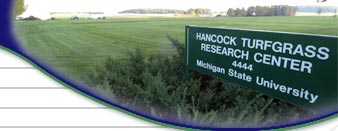
Field Experiments: Experiments will be initiated at the MSU Hancock Turfgrass Research Center to examine the alleopathic activity of maple mulch under natural Michigan environmental conditions. The experimental area of established turfgrass will use a combination of cultural practices to maximize broadleaf weed infestation potential during the first yeat; thereafter, BMP will be used to evaluate long term broadleaf weed control. Fertilization and irrigation treatments will be eliminated 90 days prior to the application of mulch treatments. Broadleaf herbicide treatments (2,4-D, MCPP, dicamba) will be applied to the experimental area 45 and 28 days prior to application of mulch treatments to eliminate established dandelion plants. Sunlight penetration of the turfgrass canopy and open soil surfaces are crucial to weed seed germination. In an effort to facilitate weed seed germination, mowing height will be reduced from 3 in. to 1 in. and plots will be thinned with a vertical flailing knife unit immediately prior to application of dandelion seed (V&J Farms, Woodstock, Ill.). Clippings and thatch will be removed and soil samples will be taken at a depth of 0-4 in. Dandelion seed will be applied to the plots (238 seeds/ft2) to establish a population of broadleaf weeds. The timing of sowing dandelion seeds will coincide with autumn soil temperatures between 55-65°F at a 0-2 in. depth. Application of four maple leaf species/cultivar treatments will be applied at rates of 0.5kg m -1 and 1.5kg m -1, and at two particles sizes where medium = particle size resulting form vacuum mulch with Popular Blower/Vac; and fine = vacuum mulched, then re-mulched with Mighty Mac Mulcher [1/2 in screen]. Controls will consist of non-maple leaf mulch applied (Oak, Quercus), an inert cellulose mulch (blank newsprint), and no leaves applied. Treatments will be evaluated based on broadleaf weed control (number of broadleaf weeds per plot), and turf quality (turf density, color, leaf reflectance, and surface hardness), C/N ratio, as well as turfgrass foliar and soil samples to quantify nutrient availability and uptake in response to mulch treatments. Field experiments will be replicated over three years with additional maple mulch applications to investigate the effect of single versus sequential applications on broadleaf weed control. Analysis of protein content in leaf litter mulch will be determined to quantify N that may be available from mulch application and therefore influence nutrient management in sustainable turfgrass systems.
POTENTIAL IMPACT ON TURFGRASS INDUSTRIES
Public awareness of chemical applications to turfgrass has increased in recent years. This has led to the perception of excessive application of synthetic chemicals in managed turfgrass systems. This research can identify the potential use of a natural, organic herbicide for the control of broadleaf weeds. The clear benefits of this research to linkages involving better environmental stewardship and sustainability will enhance potential intramural grant awards from national funding sources after patents can be secured. Sales of this organic herbicide would have the potential to reach a national market. Thus, once application protocols for maple leaf mulch can be established and verified; subsequent research funding would be sought from Federal competitive grants to identify the chemical structure of the active compound responsible for herbicide activity.
The proposed research could provide the information for use of maple leaf litter as an effective organic herbicide. National distribution and sales of this product could provide economic return for sugar maple orchards, municipalities that have abundant sources of maple litter within the state of Michigan and turfgrass managers who have maple leaf litter that could be mulched.
TIME LINE
YEAR ONE (2007) EXPERIMENTS
April Turfgrass prepared at Hancock Turfgrass Research Center for planting;
May – August Field experiments – Year 1
September – October Post-emergence Experiments;
Greenhouse-based Whole Plant Growth
November – December Data Analysis.
YEAR TWO (2008) EXPERIMENTS
January Project GREEEN funding sought;
May – October Replication of Controlled Environment and Field Experiments
November - December Data Analysis; Patent Investigation
YEAR THREE (2009) EXPERIMENTS
January Continuing Project GREEEN funding sought;
May – October Replication of Field Experiments
November - December Data Analysis; Patent application process initiated; Extramural funding sought.
LITERATURE CITED
Beard, J.B. 1973. Turfgrass: Science and Culture. Prentice-Hall, Inc. Englewood Cliffs, N.J.
Christians, N. 1993. A natural product for the control of annual weeds. Golf Course Management. Oct. pg 74-76.
Hardebeck, G. and Z. Reicher. 2000. Mulching tree leaves: an alternative to disposal. Grounds Maintenance. August. 35:C18, C20, C22.
Kowalewski, A.R. 2006 Organically Derived Weed Control Methods. MS Thesis, MSU. (in press)
Nikolai, T.A. and P.E. Rieke. 1999. The role of turfgrass in leaf litter disposal. Crop Science. 91:132.
Rice, E.L. 1995. Biological Control of Weeds and Plant Diseases: Advances in Applied Allelopathy. University of Oklahoma Press: Norman and London.